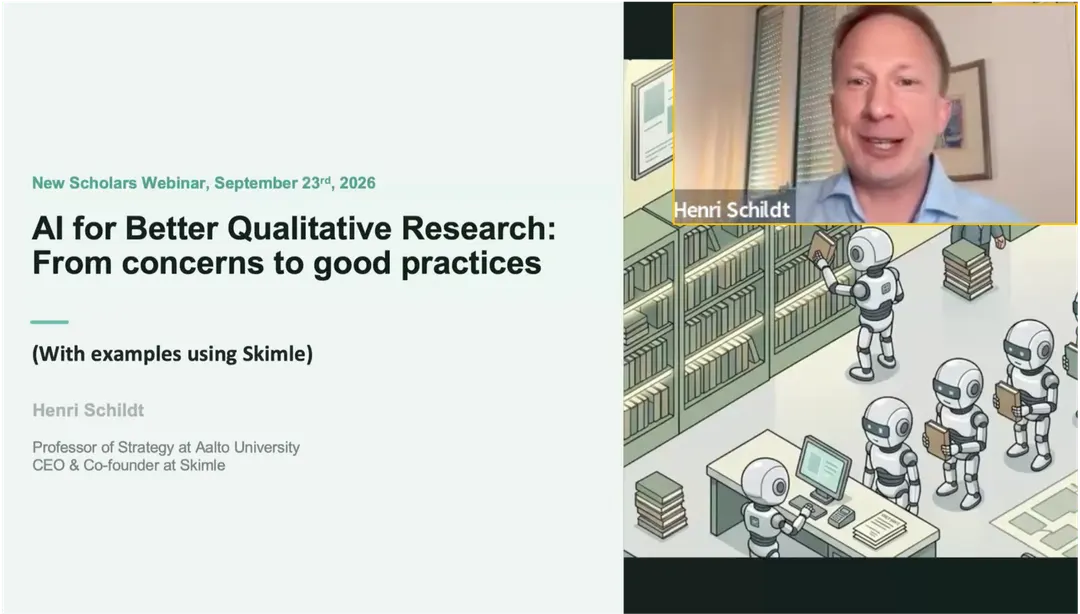
How do you use AI in qualitative research without giving up the rigour, immersion and interpretive craft that make the work worth doing? That was the question Henri Schildt, Professor of Strategy at Aalto University and co-founder of Skimle, took on at the New Scholars webinar on 23 September 2026. His framing is that moving to AI is like moving from walking to cycling: you go much faster, but you can also crack your skull if you ride without a helmet.
Watch the recording by clicking on the video below.
The talk weighs AI's distinctive strengths (practically unlimited attention, the same granularity of coding across every document and every wave of data, and no sunk cost when you want to recode the corpus a third time) against its real risks: confidentiality, hallucinated quotes, black-box outputs and opaque agentic systems. The biggest risk, he argues, is cognitive surrender to AI output that looks compelling and is often technically correct, but is too obvious to build a study around. We cover these failure modes in more depth in hallucinations, context and the black box.
What does responsible AI use look like in practice?
Henri looks at AI through three lenses. The first is the core analytical tasks: bottom-up coding where every extracted quote is verified to exist verbatim in the source, categorisation, summaries that link back to the original passages, and comparisons across metadata such as country or data wave. In a live demo he re-categorises the same coded data through a transaction cost economics lens in minutes, then shows why the result is weak: most quotes land in "miscellaneous", a signal that the lens does not fit the data. That is the real gain. Ideas that once took weeks to test can be tried and rejected in an afternoon. The second lens is the research lifecycle. AI helps critique interview guides for leading questions, anonymise transcripts, catalogue what is discussed where, and later check that every claim rests on several informants, surface counter-evidence and alternative explanations, and find the power quotes that carry an argument. The creative leap stays with the researcher: AI can find every criticism of a manager, but only a human can judge whether it is a self-serving attribution or evidence of bad leadership. His advice on journals is simple: always disclose what you used AI for, and keep ownership of the findings. For a longer treatment of these practices, see our guide to AI in qualitative research for academic researchers and the principle of two-way transparency.
How could AI change the qualitative research process itself?
The third lens is the most forward-looking, with three approaches in escalating order of radicality. First, replacing the "waterfall" model of design, collect, analyse and write with an iterative one, where every new interview is coded into the same scheme so the design and sampling can adapt during fieldwork rather than months after it. Second, using agentic analysis to generate the obvious dynamics and null hypotheses in a dataset, which then serve as alternative explanations your own argument has to beat. Third, building shared repositories that pair empirical cases (Enron, Dieselgate, Wells Fargo) with theory-derived coding schemes, so researchers and practitioners can see which lens explains a case best and what remains unexplained. In the closing discussion, Stine Grodal makes the point that runs through the whole session: learning to cycle did not make anyone forget how to walk, and the aim of AI in qualitative research is to go deeper, broader and bigger rather than just faster. Henri's advice to doctoral researchers follows from that: read your three to five most important interviews slowly, with pen and paper if you like, and let AI do the heavy lifting on the rest. It is the same argument we make in is AI destroying the ability to think.
Suggested reading
- Schildt, H. (2026). The case for artificial intelligence in qualitative research. Organization Studies, 47(9), 1501-1505.
- Schildt, H. (2026). Designing AI for qualitative research: predictability, transparency, and control in AI tool Skimle.com. SSRN. This paper is summarised in our perspective on responsible use of AI for analysing large document datasets covers the task and lifecycle lenses in more detail.
About the author
Henri Schildt is a Professor of Strategy at Aalto University School of Business and co-founder of Skimle. He has published more than a dozen peer-reviewed articles using qualitative methods, including work in Academy of Management Journal, Organization Science, Organization Studies and Strategic Management Journal. His research focuses on organisational strategy, innovation, and qualitative methodology. Google Scholar profile