Would you trust a number from a calculator for a high-stakes quantitative decision? Or would you want to see the spreadsheet, with its assumptions, formulas and sensitivity analysis laid out?
At Skimle we are advocating applying the same standard to qualitative research. Instead of a black-box chatbot spitting out themes, or someone skimming the material manually, you can now analyse it rigorously with an AI-assisted workflow modelled on the academic methods for thematic analysis. With Skimle, you get full transparency, manual control and the versatility to analyse your data the way you actually need to.
The calculator problem
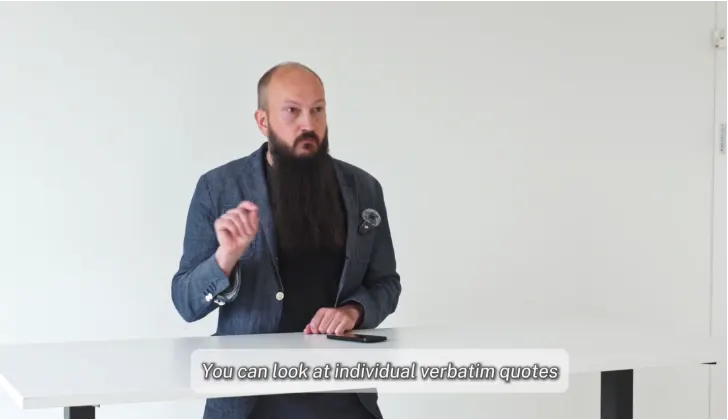
Olli's point in the video is a simple one: nobody makes a billion-euro decision off a single number typed into a calculator. You want the interim steps, the assumptions, a team that can look at the working and agree the answer is right. Qualitative research routinely informs decisions of similar weight, yet it is often handed over the way a calculator hands over a number: skim 50 interviews or a thousand customer comments, or paste them into a chatbot, and accept the three or four themes that come back.
With ordinary tools, you cannot go further than that. With Skimle you can look at every coding decision, every category, and every individual verbatim quote, see exactly what people said and how it rolls up into the summary, and freely edit any of it. You never have to accept the AI's answer as final: recode manually, change the categories, and stay in control throughout. When you are done, export the results in the format you actually need rather than copy-pasting text out of a chat window.
That is the Excel-for-text argument in full: a spreadsheet earns trust because every cell traces back to a formula you can inspect, not because the final number looks plausible. We think qualitative analysis deserves the same bargain, and it is the same case we make in more depth in our design criteria for AI-assisted qualitative analysis tools and in two-way transparency.
About the author
Olli Salo is a former Partner at McKinsey & Company where he spent 18 years helping clients understand the markets and themselves, develop winning strategies and improve their operating models. He has done over 1000 client interviews and published over 10 articles on McKinsey.com and beyond. LinkedIn profile